



Troozer.com has become a searchable name across the web. Yet, finding a simple answer about the website can be surprisingly difficult.
- Troozer.com at a Glance
- How Troozer.com Became an Interesting Search Entity
- What Does Troozer.com Publish?
- What Troozer.com Is Not Clearly Confirmed to Be
- Domain History Adds Another Layer
- Why Readers Should Check Individual Articles
- Troozer.com and the Modern Publishing Model
- Current Identity and Digital Footprint
- What Readers Can Learn From Troozer.com
- Final Takeaway
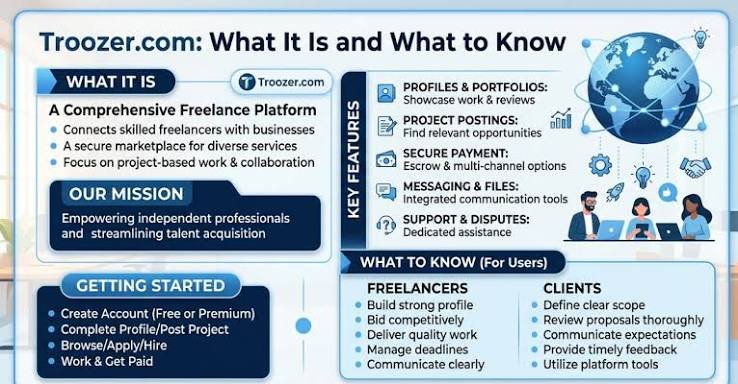
Some online pages describe it as an AI platform. Others call it a marketplace, productivity service, or digital workspace. Current evidence points to something much simpler. Troozer.com primarily operates as a multi-category digital publishing platform.
The distinction matters.
A website can publish articles about artificial intelligence without being an AI tool. It can discuss e-commerce without operating a marketplace. The same principle applies to cloud computing, finance, business, and other subjects.
Troozer.com appears designed around publishing information for readers across multiple categories. Its public descriptions identify technology, finance, business, health, education, lifestyle, travel, law, home improvement, and real estate among its coverage areas.
Troozer.com at a Glance
| Detail | Current Information |
|---|---|
| Website | Troozer.com |
| Type | Digital publishing platform |
| Main Model | Multi-category editorial content |
| Primary Format | Online articles and guides |
| Technology Coverage | Yes |
| Business & Finance | Yes |
| Lifestyle Content | Yes |
| Education & Health | Yes |
| Marketplace | Not currently confirmed |
| AI Workspace | Not currently confirmed |
| Domain Registration | March 15, 2013* |
| Server Infrastructure | Cloudflare |
| Access | Web browser |
*Domain-registration information does not necessarily show when the current website or ownership began. Available domain data lists March 15, 2013 as the registration date.
How Troozer.com Became an Interesting Search Entity
The unusual part of Troozer.com is not simply its content.
It is the conflicting information surrounding the name.
Several third-party websites have described Troozer as an all-in-one digital platform. Some mention AI features, project management, cloud storage, shopping functions, or collaboration tools. Recent examinations, however, have found little public evidence supporting those descriptions as current Troozer functionality.
Troozer itself has publicly addressed this confusion. Its LinkedIn statement describes the website as a digital media and publishing platform. It also says the service is not a marketplace, financial service, or software tool.
That creates a useful distinction for readers.
Published content does not equal provided software.
If Troozer publishes an article about AI automation, that does not mean visitors receive an AI automation product. If it discusses online shopping, that does not make the website an online store.
This difference explains much of the confusion found in search results.
What Does Troozer.com Publish?
The strongest identifiable feature of Troozer.com is its broad editorial scope.
Rather than targeting one narrow audience, the platform covers several areas of everyday interest.
Technology and AI
Its broader technology coverage can include digital developments, artificial intelligence, software, online services, gadgets, and emerging trends.
However, readers should separate technology reporting from technology products.
A publication can explain an AI tool without developing that tool. It can discuss software without offering software subscriptions.
That distinction is especially useful when researching Troozer.com because some external descriptions blur the line between the subjects covered by the website and the services supposedly offered by it.
Business and Finance
Business and finance represent another major content area.
General publishing platforms often cover entrepreneurship, companies, money management, markets, financial concepts, and business trends.
Such material can provide an introductory understanding of a topic. Still, financial information deserves extra verification when real money is involved.
Readers considering investments, loans, taxes, or major financial decisions should check regulators, financial institutions, professional advisers, and primary documents.
Education and Health
Troozer’s reported categories also extend into education and health.
Education content can serve readers searching for explanations, learning resources, or general knowledge.
Health content requires a different standard. Medical claims can become outdated or lack sufficient context. Readers should therefore verify important health information through qualified medical professionals and authoritative health organizations.
The same principle applies to legal content.
A general article may explain an idea. It does not automatically replace jurisdiction-specific professional advice.
What Troozer.com Is Not Clearly Confirmed to Be
This is where a fresh look at Troozer.com becomes useful.
Based on the current public evidence reviewed, the website should not automatically be described as:
- AI workspace — no strong current evidence confirms this.
- Cloud storage — third-party descriptions mention it, but current functionality is unconfirmed.
- Project management tool — the publishing structure does not demonstrate this service.
- Online marketplace — Troozer’s own public statement rejects this description.
- Payment platform — no confirmed transaction model is identified.
- Shopping engine — product-comparison claims remain unverified.
- Enterprise software — the visible model is primarily editorial publishing.
These distinctions are important for SEO readers.
Repeated claims can appear authoritative simply because several websites repeat them. Repetition, however, does not create primary-source evidence.
Domain History Adds Another Layer
Troozer.com is not a newly registered domain.
Available domain information lists March 15, 2013 as the registration date. The same source records the domain as active through a current registration period extending to 2030.
That history needs context.
A domain’s age does not automatically prove the age of its current business model. Domains can change owners, purposes, designs, and editorial strategies.
So, the 2013 registration date should be treated as domain-history information rather than proof that the current Troozer.com operation has existed unchanged since 2013.
There is also evidence of older editorial material associated with the domain. Recent examinations have identified indexed content dating back to 2020, showing a conventional article format with authorship and publication details.
Why Readers Should Check Individual Articles
A broad publication creates an interesting challenge.
One website may discuss technology, finance, health, law, education, and real estate. Each field requires different expertise.
A strong technology article does not automatically establish expertise in finance. A useful finance article does not establish medical authority.
Readers should therefore evaluate articles individually.
Look for:
- Named author — Who wrote the article?
- Publication date — Is the information current?
- Primary sources — Are original sources cited?
- Specific evidence — Are claims supported?
- Updates — Has old information been reviewed?
- Specialist context — Does the topic require professional expertise?
This approach provides a better credibility check than judging an entire domain from one article.
Troozer.com and the Modern Publishing Model
Troozer.com reflects a broader change in online publishing.
General-interest websites can now cover many topics under one domain. Search engines can send readers directly to individual articles rather than the homepage.
That changes how readers experience a publication.
Someone may arrive through a finance article. Another visitor may enter through technology. A third may discover a lifestyle guide.
The homepage becomes less important than individual content quality.
For a multi-category publisher, this creates a demanding editorial challenge. Every category needs accurate sourcing, useful context, clear authorship, and regular maintenance.
Without those elements, broad coverage can become shallow.
With them, a general publication can serve as a useful starting point for readers exploring unfamiliar subjects.
Current Identity and Digital Footprint
Current public information presents Troozer.com primarily as an editorial publishing brand.
Crunchbase describes Troozer.com as a private, for-profit digital publishing platform focused on technology, finance, business, and related subjects. It lists the operating status as active.
Troozer’s own LinkedIn communication provides a similar description. It identifies the website as an open-access content platform and says users do not need mandatory account creation to access its content.
The available evidence therefore gives a more consistent picture than some third-party descriptions suggest.
Troozer.com is primarily a content destination.
Its value should be judged through its articles, sourcing, editorial transparency, and usefulness rather than through claims about tools that are not visibly confirmed.
What Readers Can Learn From Troozer.com
Troozer.com’s story offers a few practical lessons about internet research.
- Check primary sources — Search results can repeat mistakes.
- Separate content from products — Articles do not prove functionality.
- Verify dates — Old information can describe an earlier website.
- Inspect authorship — Expertise matters across specialized topics.
- Compare evidence — Independent claims need supporting documentation.
The biggest lesson is simple.
A website’s name can create one impression. Its actual structure can tell another story.
For Troozer.com, current evidence supports the identity of a multi-category digital publishing platform rather than a confirmed AI workspace, marketplace, or productivity application.
Final Takeaway
Troozer.com is best understood as a broad digital publishing website.
Its content footprint reaches technology, finance, business, education, health, lifestyle, travel, law, home improvement, real estate, and related subjects.
The biggest source of confusion comes from inconsistent descriptions across third-party websites.
Some sources portray Troozer as software. Others describe a marketplace or AI platform. Current first-party information provides a different picture: an editorial publication without the transaction, payment, or software functions claimed by some outside sources.
For readers, the safest approach is straightforward. Use Troozer.com as an information source, but evaluate important claims individually. For financial, medical, legal, or technical decisions, verify key information through authoritative primary sources.
Disclaimer: This article is compiled from publicly available website information, domain records, published statements, and independent online sources. It is intended solely for educational and informational purposes. Website features, ownership, categories, and other details may change over time.
Read more:Business Tips RobTheCoins: Strategies for Smarter Business Growth
